High-Intensity Training vs Volume: Two Old-School Philosophies
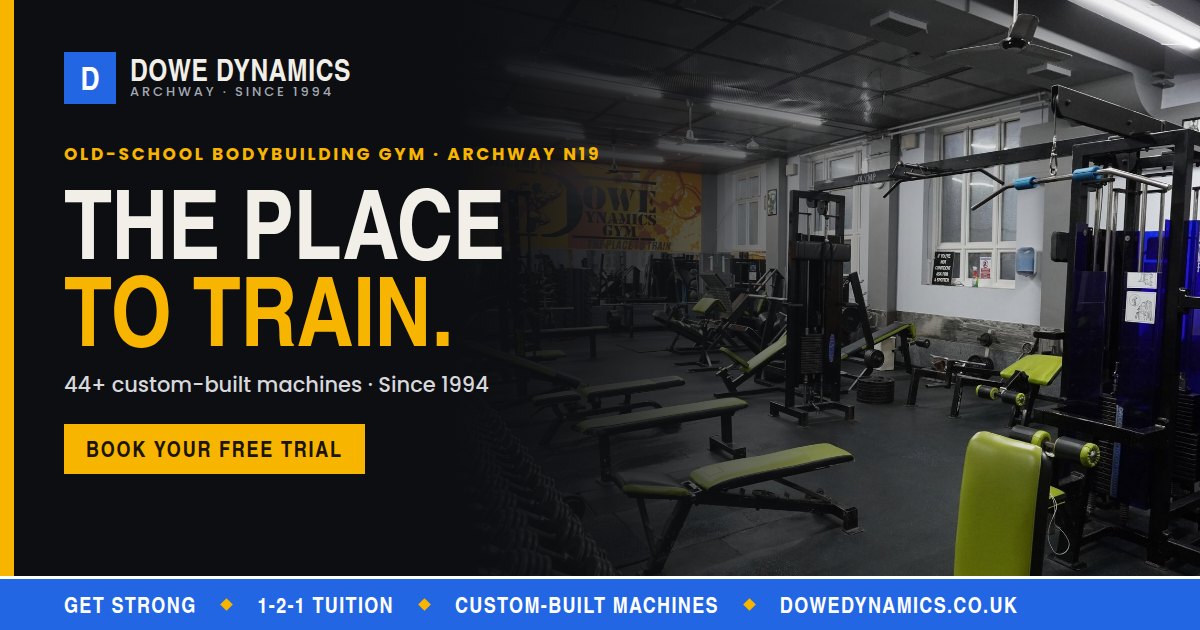
High-intensity training (HIT) and high-volume training are the two great old-school arguments in bodybuilding. HIT says do very few sets and take each one past the point of failure. Volume says do lots of sets and let the total workload do the job. Both have built impressive physiques, and research suggests both can work when effort and progression are in place. At Dowe Dynamics in Archway, with poster walls straight out of the 90s and machines built for heavy iron, you will see lifters training both ways.
Where high intensity training in bodybuilding came from
HIT is most closely linked with Arthur Jones, the inventor of Nautilus machines, and with Mike Mentzer, who popularised his “Heavy Duty” approach in the late 1970s and 1980s. The idea was simple: one or two all-out sets per exercise, trained to complete failure and sometimes beyond with forced reps or negatives, then plenty of rest before training that muscle again.
In the 1990s, many lifters adopted a lower-volume, very high-effort style, often with only one hard working set after warm-ups.
What a HIT session looks like
- Thorough warm-up sets, building up in weight
- One, maybe two, working sets per exercise
- Each set taken to failure, often with a slow, controlled tempo
- Short sessions, sometimes under 45 minutes
- Several days of rest before the same muscle is trained again
Where volume training came from
High-volume training is the classic Golden Era approach of the 1960s and 1970s. Lifters trained each body part with many sets, often 15-20 or more per session, sometimes training twice a day. The focus was on pump, feel and sheer workload.
What a volume session looks like
- Several exercises per muscle
- Three to five working sets per exercise
- Sets usually stopped a rep or two short of failure
- Longer sessions, often 90 minutes or more
- Each muscle trained hard, then rested for several days
What each approach does well
Strengths of HIT
- Time efficient. Ideal for busy people who still want to train seriously.
- Teaches real effort. Many lifters never discover what a truly hard set feels like until they try HIT.
- Easy to track. One working set per exercise makes progress very clear.
Strengths of volume
- More practice. More sets means more chances to groove technique and feel the muscle.
- Forgiving. If one set is not quite hard enough, the others make up for it.
- Research support. Studies generally suggest that, up to a point, more weekly sets tend to produce more growth.
The downsides of each
HIT asks a lot mentally. Taking every set to true failure is draining, and on heavy compound lifts it can raise the risk of form breaking down. It is also easy to think you have hit failure when you have stopped early, which leaves you with very little work done.
Volume training has the opposite problem. With so many sets, people start pacing themselves, and many of those sets end up too easy to count. Long sessions are also hard to fit around work and family, and recovery can suffer if volume keeps creeping up. For more on effort levels, see our guide to training to failure.
Borrowing the best of both
Most lifters do best somewhere in the middle. A practical version looks like this:
- Moderate volume. Around 10-20 hard sets per muscle per week is a common evidence-based range.
- Real effort on every working set. Finish most sets within one to three reps of failure.
- Failure on safer exercises. Take machine and isolation work like the pec deck, leg extension or curl to failure, and keep a rep or two in reserve on heavy barbell lifts.
- Fewer junk sets. If a set is not hard, it does not count.
Our guide to how heavy you should lift explains how to judge reps in reserve so you can apply this properly.
Which should you choose?
Try HIT if you are short on time, train alone, and enjoy pushing yourself to the limit. Try a volume approach if you enjoy longer sessions, like variety, and recover well. If you cannot decide, run each style for six to eight weeks and compare your training log, your energy and how much you enjoyed it.
Machines are particularly well suited to both styles. They let you train to failure safely without a spotter, and plate-loaded and selectorised stacks make it easy to repeat sets and track progress.
FAQs
Is HIT better than volume for building muscle?
Neither is clearly better for everyone. Research suggests that effort and progressive overload matter most, with moderate volume working well for many people.
Is one set per exercise enough?
For beginners and busy lifters, one or two very hard sets can produce good results. More experienced lifters often need more weekly sets to keep growing.
Is training to failure dangerous?
Not on most machines and isolation exercises. On heavy free-weight lifts, many coaches advise stopping a rep or two short to keep form solid.
Can I combine HIT and volume?
Yes. Many lifters use moderate volume with a final all-out set on safer exercises, which captures the strengths of both.
Train old-school in Archway
Whichever philosophy you lean towards, you will find the iron to do it at Dowe Dynamics, the independent gym Ian Dowe opened in 1994. Our coaches can help you choose and plan an approach, and our Elite Membership is £45 a month with limited spaces. Book your free trial and see it for yourself.

