Machines vs Free Weights: Which Is Better for Building Muscle?
Ask ten lifters which is better for building muscle and you will probably get ten strong opinions. Some swear that only barbells and dumbbells build real size. Others get great results almost entirely on machines. The truth about machines vs free weights is less dramatic: both work, they each have clear strengths, and most people do best when they understand what each tool is good for and use them on purpose.
What Actually Builds Muscle
Before comparing equipment, it helps to remember what your muscles respond to. Growth comes from:
- Enough tension on the muscle, over a full range of motion.
- Sets taken close to failure, where the last few reps are genuinely hard.
- Progressive overload, adding weight, reps or quality over time.
- Enough recovery, which means food, sleep and sensible training volume.
Your muscle does not know whether the resistance comes from a barbell or a weight stack. It only knows how hard it is working. So the real question is which tool helps you apply those principles most effectively for a given exercise.
The Case for Machines
Stability lets the target muscle do the work
A machine guides the path of the movement. You do not need to balance the load, so more of your effort goes into the muscle you are trying to train. On a chest press, for example, your chest and triceps can push hard without your shoulders and core working overtime to keep a bar steady.
Loading through the full range
Well-designed machines, especially classic plate-loaded and cam-based ones, are built to keep resistance meaningful through the whole movement. Free weights are limited by gravity, so some exercises are hard at one point and almost effortless at another. A good leg extension or preacher curl machine keeps the muscle working from start to finish.
Safer to push near failure
This is a big one. Taking a set close to failure on a heavy barbell bench press without a spotter carries real risk. On a machine, if you cannot complete a rep, you simply stop and the weight rests safely. That makes it much easier to train with the intensity that drives growth, especially if you train alone.
Easier to learn
For beginners, machines remove a lot of the technical barriers. You can focus on feeling the muscle and building strength while your coordination develops.
The Case for Free Weights
Coordination and stabiliser strength
Free weights ask more of the small stabilising muscles and your overall coordination. Learning to control a dumbbell press or a barbell row builds a kind of body control that machines do not train as directly.
Freedom of movement
Dumbbells let your joints find their own natural path. Some people find certain movements more comfortable this way, and they can adjust grip and angle freely.
Carryover to everyday strength
Picking up, carrying and controlling objects in daily life is closer to free weight training. For general athleticism, that is a genuine advantage.
Machines vs Free Weights: A Quick Comparison
- Stability (machines: High, path is guided, free weights: Low, you control the path)
- Pushing close to failure (machines: Safe without a spotter, free weights: Riskier on heavy lifts)
- Learning curve (machines: Short, free weights: Longer)
- Muscle isolation (machines: Excellent, free weights: Good, depends on technique)
- Coordination training (machines: Limited, free weights: Strong)
The Best of Both
For building muscle, the most practical approach is not to pick a side. Use each tool where it shines.
- Use machines for your hardest, closest-to-failure sets. Chest press, lat pulldown, leg press and leg extension are ideal for pushing intensity safely.
- Use free weights for movements where control and coordination matter to you, such as dumbbell presses or rows.
- Let your goals decide the balance. If your main aim is size and shape, a machine-heavy programme is completely valid. If you also play sport, add more free weight work.
- Track your numbers on both. Progress is progress, whatever the equipment.
Why We Lean Into Machines
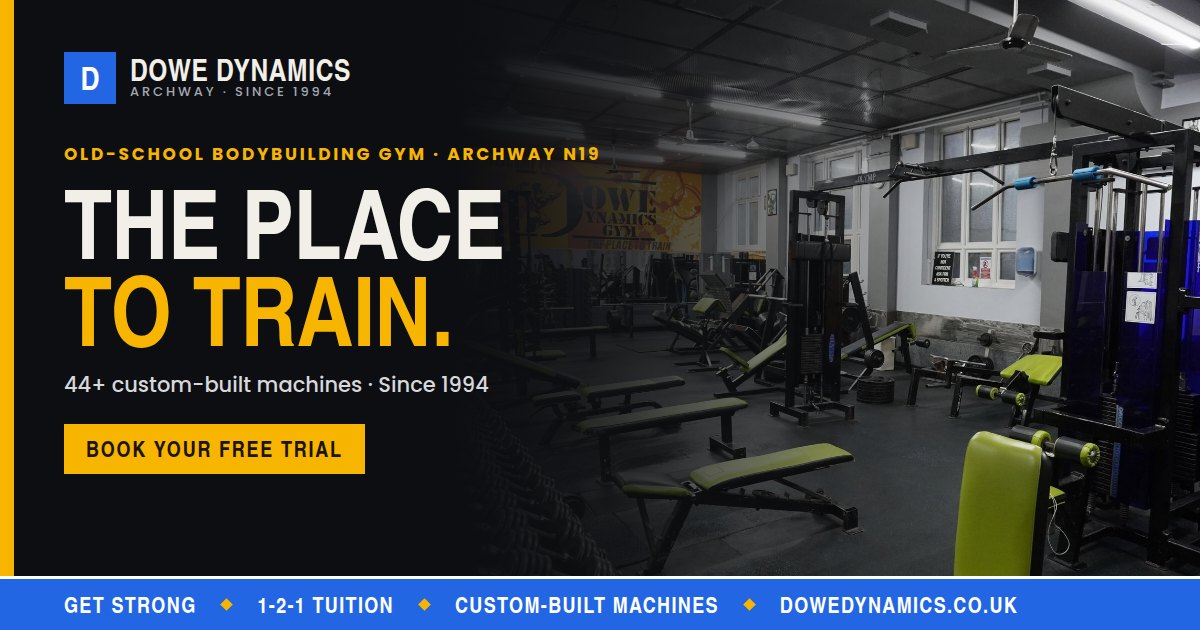
At Dowe Dynamics in Archway, the floor is built around 44+ custom-built and classic Olymp machines, including the Olymp chest press, lat pulldown, preacher curl and leg extension, plus a horizontal leg press, seated lever row and standing leg curl. That reflects decades of bodybuilding experience: machines let you train hard, safely and with real focus on the muscle. Memberships are capped too, so you are not queuing for the kit you need.
If you want to see how these machines feel compared with modern equipment, read our guide to Olymp gym machines and classic iron.
Not sure how to balance the two in your own plan? Our coaches can build a programme around your goals, whether that is body transformation, strength or boxing fitness.
FAQs
Can you build muscle using only machines?
Yes. Many people build excellent physiques with machine-based training, as long as they train close to failure, apply progressive overload and recover well.
Are free weights better for strength?
For skill-based lifts like the barbell squat or deadlift, practising those exact lifts matters. For general muscle and strength, machines and free weights can both deliver strong results.
Are machines better for beginners?
Machines are a great starting point because they guide the movement and are easier to learn safely. Beginners can add free weights as their confidence and coordination grow.
Should I do machines or free weights first in a workout?
Do whichever exercise is your priority first, while you are fresh. Many lifters do a compound movement first, then use machines to push the target muscles hard later in the session.
Try It on the Machines
The machines vs free weights debate is easier to settle when you feel the difference yourself. We are at 2-4 Navigator Square, by Archway station, a short trip from Holloway, Highgate and Kentish Town. Book your free trial and you will get time on the machines plus a complimentary session with a coach. Or head to the Dowe Dynamics homepage to find out more.

