Grip and Forearm Strength: Why It Holds Your Lifts Back
You finish a set of rows and your back still has more to give, but your hands have opened. Sound familiar? Poor grip strength is one of the most common hidden limits in the gym. It caps how much you can pull, it cuts sets short and it means the muscles you are actually trying to grow never get pushed hard enough. The good news is that grip responds quickly to a little direct work, and you do not need fancy kit to train it.
Why grip strength matters
Your hands are the link between you and the weight. In any pulling movement, if the hands give up first, the set is over regardless of how much your lats, traps or hamstrings had left.
That shows up in a few ways:
Back training stalls. Rows, pulldowns and shrugs all depend on holding on.
Your form suffers. When your grip is failing, people tend to yank the weight, shrug or round their backs.
Everyday tasks get harder. Carrying shopping up the hill from Archway station or lifting a suitcase is grip work too.
Pressing feels shakier. A firm squeeze on the handles helps you feel more stable on chest and shoulder pressing.
The three types of grip
It helps to know what you are training.
Crushing grip
Squeezing something closed, like a handshake. Trained by holding handles hard and squeezing grippers.
Support grip
Holding on to something for time, like a heavy bag or a bar during a set. This is the one that limits most gym lifts.
Pinch grip
Holding something between your fingers and thumb, like a weight plate by its rim.
Most people only need to focus on support grip and a bit of crushing grip to see a difference on their main lifts.
Simple grip and forearm work
You only need a few minutes, two or three times a week. Add one or two of these at the end of a session.
1. Static holds
Pick up a pair of heavy dumbbells, or grab the handles of a loaded machine at the lockout position, and hold for 20 to 40 seconds. Stand tall, shoulders back. Do 2 to 3 holds. When you can hold for 40 seconds, go heavier.
2. Farmer’s walks
Hold heavy dumbbells by your sides and walk steady laps in a clear area. Aim for 20 to 30 metres or about 30 seconds per round. This trains grip, traps and core together.
3. Wrist curls
Sit with your forearms resting on a bench, palms up, holding a light dumbbell or bar. Let it roll down to your fingertips, then curl it back up. 2 to 3 sets of 15 to 20 reps.
4. Reverse wrist curls
The same position with palms facing down, lifting the back of the hand. Use a lighter weight. 2 sets of 15 to 20. This balances out the front of the forearm.
5. Plate pinches
Hold two smooth weight plates together between your fingers and thumb for 15 to 30 seconds. Simple, humbling and very effective.
Stop letting your grip hide behind straps
Lifting straps are useful, and we are not against them. On a heavy final set of rows or shrugs where grip would cut you short, they let your back do the work. The problem is when they are used on every set, so the hands never get any stronger.
A sensible approach:
Do your warm-ups and first working sets without straps.
Use straps only on the heaviest sets where your grip clearly fails before the target muscle.
Keep a little direct grip work in your week so the gap does not grow.
Get more out of the machines you already use
Many of our Olymp machines already train your grip if you pay attention to it:
Seated lever row: Squeeze the handles hard throughout, do not just hook them.
Olymp lat pulldown: Use a full grip with the thumb wrapped around, and hold the bottom for a one-second squeeze.
Lever power station: Hanging from the pull-up handles for time is excellent support grip work.
For a fuller look at the back work that grip supports, see our back workout on machines.
A quick weekly plan
Session one (pull day): 3 static holds at the end, 30 seconds each.
Session two (any day): 2 rounds of farmer’s walks plus 2 sets of wrist curls.
Session three (optional): 2 plate pinch holds and 2 sets of reverse wrist curls.
Give it four to six weeks and most people notice they can hold on longer during their working sets.
Training grip at Dowe Dynamics
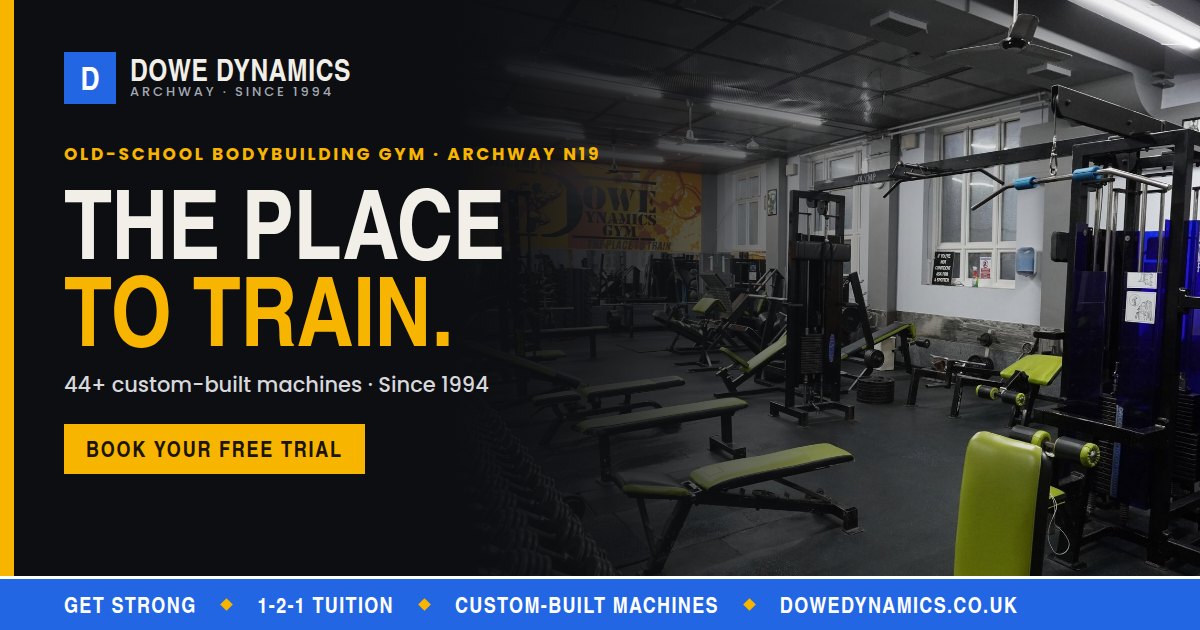
Our gym in Archway, N19, has the dumbbells, machines and floor space you need, and with membership capped you will not be weaving through a crowd for your farmer’s walks. We are a short walk from the Northern line and easy to reach from Upper Holloway, Highgate and Tufnell Park.
FAQs
How long does it take to improve grip strength?
Many people notice a difference within a few weeks of consistent training, as long as they progress the weight or the holding time.
Should I train grip every day?
There is no need. Two or three short sessions a week is plenty for most lifters, alongside your normal pulling work.
Are lifting straps bad for grip?
Not if used selectively. Straps on your heaviest sets are fine, but train without them most of the time so your hands keep up.
What if my wrists or elbows ache from grip work?
Reduce the load and volume. If the ache continues, check with a GP or physio before carrying on.
Come and get a grip
Book a free trial on our membership page, train on the full floor at your own pace, or claim a complimentary PT session if you want a coach. No pressure, just good iron.

