The Old-School Body Part Split: Is the 'Bro Split' Still Worth It?
The **bro split** gets a lot of stick online. Chest on Monday, back on Tuesday, shoulders, arms, legs, one muscle group a day. Critics say it is outdated and that nobody should train a muscle only once a week. Yet walk past the Mr Universe posters on our walls in Archway and you are looking at physiques that were largely built on body part splits. So is it still worth doing? Here is a fair look.
## What is a bro split?
Also called a body part split, this approach trains one or two muscle groups per session, usually across five days a week. Each muscle gets a big dose of work once a week, then a full week to recover before it is hit directly again.
A typical layout:
- **Monday:** Chest
- **Tuesday:** Back
- **Wednesday:** Shoulders
- **Thursday:** Arms
- **Friday:** Legs
- **Saturday and Sunday:** Rest
## Golden-era roots
Body part training grew up in the bodybuilding gyms of the 1970s and 80s. Competitors were chasing detail and fullness in every muscle, and a whole session devoted to one area let them attack it from several angles. Many of those lifters also trained twice a day or used double splits, which is a different conversation altogether.
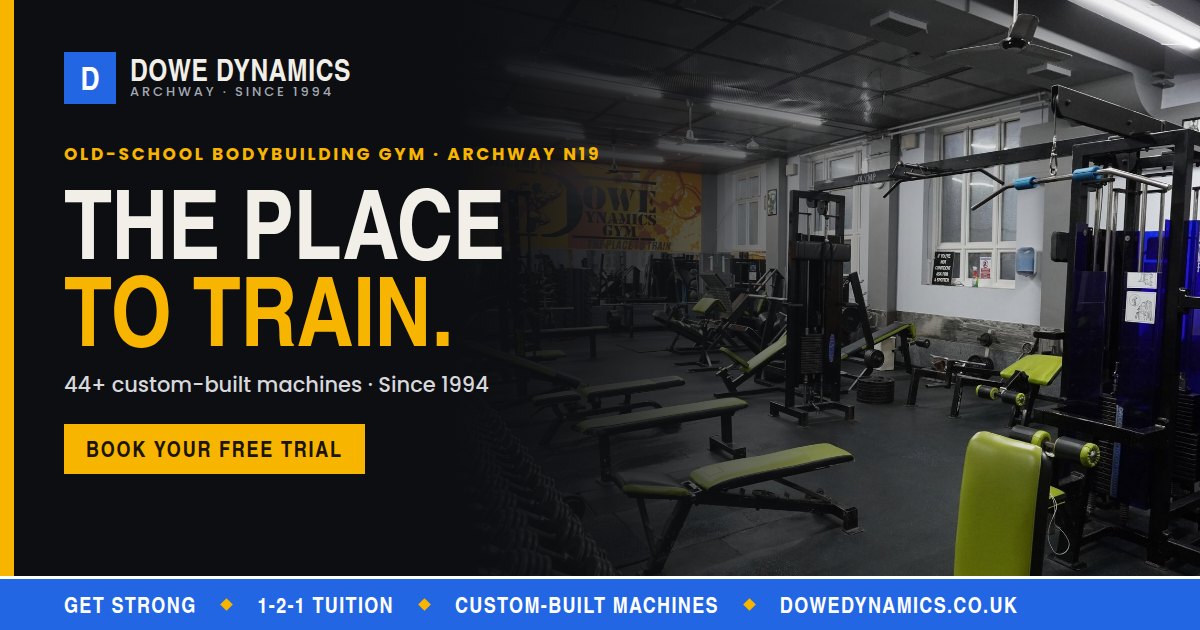
That culture is part of why Dowe Dynamics exists. Ian Dowe opened the gym in 1994 after years of competing, and the floor is built around chrome, steel and Olymp machines that suit this style of training. If you are interested in the bigger picture, our article on [golden-era bodybuilding training](https://dowedynamics.co.uk/post/golden-era-bodybuilding-training) goes into more depth.
## The case against the body part split
The main criticism is frequency. Research and coaching experience over the years have generally pointed towards training each muscle around twice a week as a good default for growth. On a strict body part split, each muscle gets one session.
Other common points:
- **Missed days hurt more.** Miss leg day and your legs go two weeks without direct work.
- **Very long sessions.** Cramming 20 sets for one muscle into a single workout means the later sets are often low quality.
- **Lots of soreness.** A big single session can leave you sore for days.
## The case for it
The criticism is not the whole story.
- **Indirect work adds up.** Your triceps work on chest and shoulder day. Your biceps and rear delts work on back day. So many muscles actually get trained more than once a week.
- **Focus.** One muscle per day lets you concentrate fully on the mind-muscle connection and attack weak areas.
- **Recovery between sessions.** Each muscle has a week to recover from a hard workout.
- **Enjoyment.** Many people simply love training this way. A programme you enjoy is one you stick to, and consistency beats a theoretically perfect plan you abandon after a month.
## Who the classic split suits
- **Experienced lifters** who already have a solid base and want to bring up specific body parts.
- **People who can train five days a week reliably** and rarely miss sessions.
- **Those who enjoy the classic bodybuilding approach** and are motivated by it.
## Who might be better off with something else
- **Beginners**, who usually progress faster with full-body or upper lower training that repeats key movements more often.
- **People with unpredictable schedules**, where a missed day leaves a gap.
- **Anyone who can only train three times a week.**
## A sample 5-day bro split
Keep sessions to around 12 to 16 hard sets. Rest 90 seconds to two minutes between sets on bigger exercises.
### Day 1: Chest
1. Olymp chest press: 4 sets of 6 to 10
2. Incline dumbbell press: 3 sets of 8 to 12
3. Dumbbell or machine fly: 3 sets of 10 to 15
4. Weighted dip: 2 sets of 8 to 12
### Day 2: Back
1. Olymp lat pulldown: 4 sets of 8 to 10
2. Seated lever row: 4 sets of 8 to 10
3. Single-arm row: 3 sets of 10 to 12 each side
4. Straight-arm pulldown: 2 sets of 12 to 15
### Day 3: Shoulders
1. Machine shoulder press: 4 sets of 8 to 10
2. Lateral raises: 4 sets of 12 to 15
3. Rear delt fly: 3 sets of 12 to 15
4. Shrugs: 3 sets of 10 to 12
### Day 4: Arms
1. Olymp preacher curl: 3 sets of 8 to 12
2. Tricep dip machine: 3 sets of 8 to 12
3. Hammer curls: 3 sets of 10 to 12
4. Overhead tricep extension: 3 sets of 10 to 15
### Day 5: Legs
1. Horizontal leg press: 4 sets of 8 to 12
2. Standing leg curl: 4 sets of 10 to 12 each leg
3. Olymp leg extension: 3 sets of 12 to 15
4. Calf raises: 4 sets of 10 to 15
## Making it work better
If you like the format but want more frequency, try a hybrid. Keep the five days, but add a few sets for lagging muscles on another day, for example two sets of lateral raises on chest day and two sets of curls on leg day. You keep the focus of the classic split and squeeze in a second weekly hit.
## FAQs
### Is a bro split good for building muscle?
It can be, especially for experienced lifters who train hard and consistently. Many people do well on it.
### How many days a week is a body part split?
Usually five, with each day focused on one or two muscle groups.
### Is a 5 day split better than full body?
Neither is automatically better. Beginners often do better with full-body training, while experienced lifters may enjoy the focus of a split.
### Can I train this way if I am natural?
Yes. Keep sessions sensible, progress your weights and make sure total weekly volume for each muscle is adequate.
## Train the classic way
Our gym at 2-4 Navigator Square, near Archway station, was built for this style of training. Find out more about us on our [home page](https://dowedynamics.co.uk/), then book a free trial through the [membership page](https://dowedynamics.co.uk/gym-in-archway-dowe-dynamics-memberships), complete with a complimentary session with a coach.
Back to Blog
