How the Golden-Era Bodybuilders Trained (and How You Can Too)
Long before fitness apps and influencer programmes, the physiques that still fill gym walls today were built with simple tools, hard work and a handful of principles that rarely changed. Golden era bodybuilding training, roughly the 1970s through to the 1990s, was about volume, patience, careful splits and a fierce focus on how each muscle felt under load. The good news is that none of it needs a time machine. With the right machines, a sensible plan and a bit of discipline, you can train the same way in Archway this week.
What Made the Golden Era Different
The lifters of that period had no wearable trackers. They had time under the bar, trial and error, and training partners who told them the truth. Several themes come up again and again.
- High training volume. Many sets per muscle group, often spread across several exercises.
- Split routines. Body parts trained on separate days so each one could be worked hard and then rested.
- The mind-muscle connection. Lifting a weight was never enough. The aim was to feel the target muscle doing the work on every rep.
- Symmetry and proportion. The goal was a balanced, flowing physique, not just one or two big body parts.
- Consistency over novelty. The same core movements, done well, for years.
The Core Principles of Golden Era Bodybuilding Training
1. Volume, but earned
Classic routines often ran to 15 or 20 sets for a body part. That works when you have built up to it over years. For most people today, a modern version looks like 10 to 16 hard sets per muscle per week, spread over one or two sessions. Start at the lower end and add sets only when you are recovering well and still progressing.
2. Split routines that give each muscle its day
Splits were the backbone of old-school programming. A few that still work well:
- Push, pull, legs: chest, shoulders and triceps; back and biceps; legs and calves.
- Upper and lower: two upper days and two lower days a week.
- Body part split: chest, back, legs, shoulders and arms on separate days, for those who can train five times a week.
Pick the split that fits your week. Three focused sessions beat five half-hearted ones.
3. Feel every rep
The mind-muscle connection simply means controlling the weight, squeezing at peak contraction and lowering slowly. A weight you can feel in the target muscle is usually worth more than a heavier one you just move. Machines help because they keep the path steady, so your attention stays on the muscle.
4. Build for symmetry
Golden-era physiques were judged on shape as much as size, so rear delts, hamstrings and calves got the same respect as the showy muscles. Put your weak points first in the session, when you are fresh.
5. Take pride in the basics
Presses, rows, pulldowns, curls, leg presses and extensions. The classics stayed in routines because they deliver. Master them before you look for anything fancier.
A Modern Golden-Era Week
Here is a practical push, pull, legs plan you can run on the machines at our gym. Rest 60 to 120 seconds between sets, and take the last set of each exercise close to failure with good form.
Day 1: Push
- Olymp chest press: 4 sets of 8-10
- Tricep dip machine: 3 sets of 8-12
- Lateral raises: 3 sets of 12-15
Day 2: Pull
- Olymp lat pulldown: 4 sets of 8-12
- Seated lever row: 4 sets of 8-12
- Olymp preacher curl: 3 sets of 10-12
- Rear delt work: 3 sets of 12-15
Day 3: Legs
- Horizontal leg press: 4 sets of 10-12
- Olymp leg extension: 3 sets of 12-15
- Standing leg curl: 3 sets of 10-12 each side
- Adjustable ab bench crunches: 3 sets of 12-15
Repeat the cycle twice a week if your recovery allows, or run it once with a rest day between each session. Add weight or reps when you hit the top of the range on all sets.
The Old-School Habits Outside the Gym
- Eat enough food, with protein at each meal. Muscle is hard to build on too little.
- Sleep properly. Growth happens away from the gym.
- Keep a training log. The oldest progress tool there is, and it still works.
Training in a Golden-Era Setting
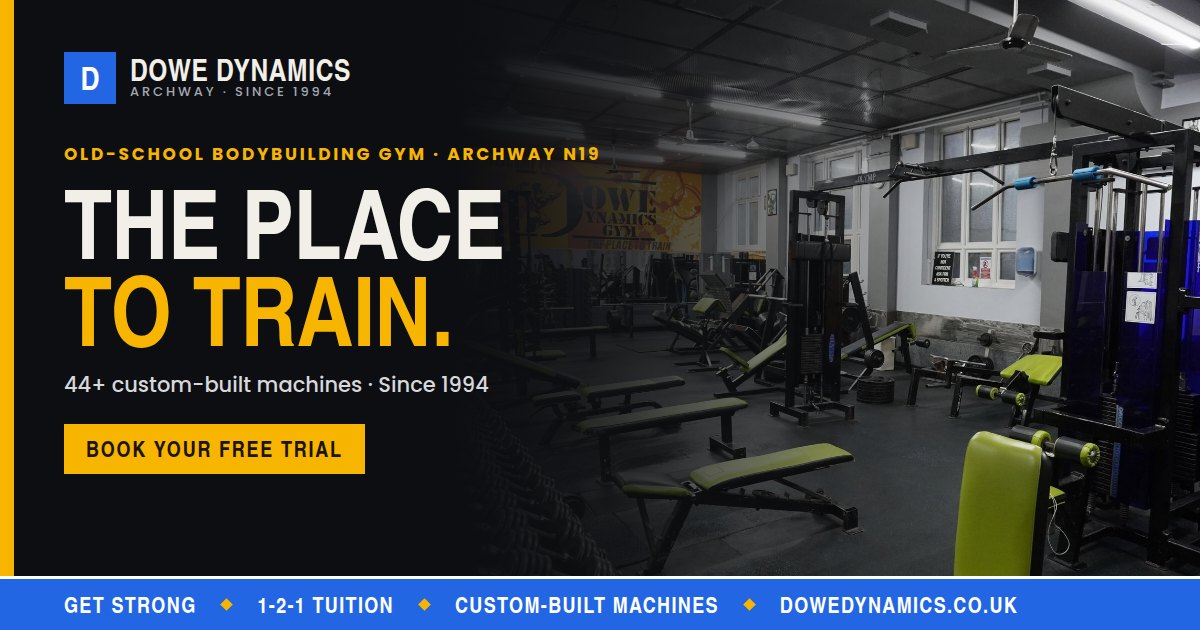
Atmosphere matters. Surrounded by Mr Universe posters, signed photos of the legends and chrome and steel, it is easier to take the session seriously. At Dowe Dynamics in Archway, that is the room you train in every day. The gym was opened in 1994 by Ian Dowe, a world champion bodybuilder, and it has never chased trends. There is no neon and no smoothie bar, just 44+ custom-built and classic Olymp machines and a floor that stays quiet because memberships are capped.
If you want to dig deeper into why this kind of gym suits classic training so well, read our guide on what an old-school gym really is.
FAQs
Did golden-era bodybuilders train every day?
Many trained six days a week, but they had built up to it over years. For most people, three to five focused sessions a week is more sustainable and still delivers excellent results.
Is high volume training good for beginners?
Not straight away. Beginners grow well on modest volume. Start with around 8 to 10 sets per muscle per week and build up as your recovery and technique improve.
Can I build a classic physique using machines?
Yes. Machines load muscles through a controlled path and let you push hard safely, which suits the mind-muscle approach.
How long does it take to see results from old-school training?
Most people notice strength gains within a few weeks and visible changes within a few months of consistent training, eating and sleep. The classic physiques took years, and that patience is part of the lesson.
Train the Classic Way in Archway
If golden era bodybuilding training is what you are after, come and try it in the right setting. We are at 2-4 Navigator Square, a short walk from Archway station, and easy to reach from Highgate, Holloway and Tufnell Park. Book your free trial, train on the machines and get a complimentary session with a coach, with no pressure and no hard sell. You can also call us on 020 7281 2267.

